
This work is devoted to monitoring the migration of heavy metals along the Syrdarya River bed in Tajikistan and determining the rate of their sedimentation. The concentrations of heavy elements As, Cd, Cu, Ni, Pb and Zn in water samples collected at points along the river were used to determine the concentrations of elements, their migration and sedimentation rate depending on the acid-base conditions of the aquatic environment. Water samples were collected at five points along the river bed, starting from the section where the river crosses the border of Kyrgyzstan and Tajikistan (“Akjar”). Atomic absorption spectrometer “A Analyst 800” was used to analyze heavy metals. It was found that the main form of formation of complexes of the studied heavy metals in the aquatic environment is their hydroxides and the sedimentation rate increases with an increase in the alkalinity of the environment. In addition to anthropogenic factors, natural factors such as water erosion of rocks play a special role in the formation and change of the chemical composition of water bodies. The mobility of heavy metals in the aquatic environment and their uptake by aquatic components of the biosphere largely depend on their state. The state of heavy metals is determined by the types of complexes of heavy metals with ligands and is reflected in the degree of their binding to active centers. Movement of chemical elements by river runoff along the water-soil-plant chain depends on the biological properties of the flora of a given territory and individual elements and is characterized by the transfer coefficient. In turn, the transfer coefficient depends on the soil condition and agrochemistry, pH, clay minerals, chemical composition of irrigation water Ca2+, K+, amount of organic matter in the soil, plant species and other environmental conditions. Taking into account that water resources of most rivers in Central Asia are widely used for irrigation of agricultural lands planned and regular monitoring of hydrochemical parameters of rivers is of special importance. The results of monitoring the distribution of heavy metals (Cd, Zn, As, Pb, Cu, Cr) in the Syrdarya River are presented. It is noted that the regularity of changes in the concentration of elements from the upper to the lower reaches of the Syrdarya River on the territory of Tajikistan is not traceable. It is assumed that the occurrence of such a situation is largely due to the formation of complex compounds of metals with inorganic and organic substances.
| Published in | International Journal of Atmospheric and Oceanic Sciences (Volume 9, Issue 1) |
| DOI | 10.11648/j.ijaos.20250901.16 |
| Page(s) | 58-65 |
| Creative Commons |
This is an Open Access article, distributed under the terms of the Creative Commons Attribution 4.0 International License (http://creativecommons.org/licenses/by/4.0/), which permits unrestricted use, distribution and reproduction in any medium or format, provided the original work is properly cited. |
| Copyright |
Copyright © The Author(s), 2025. Published by Science Publishing Group |
Kairakkum Reservoir, Syrdarya, Agriculture, Irrigation, Hydrochemistry, Heavy Metals, Migration, Sedimentation Rate, Adsorption, Runoff
Metal | The existence form of metal | |
|---|---|---|
Zn | pH < 7 | Zn2+aq |
pH = 7−8 | [Zn(OH)]+ | |
pH>8 | [Zn(OH)2]0 | |
Cu | pH < 7 | Cu-Ligands Cu2+aq |
pH < 4 | [Cu(HPO4)]0 | |
pH > 8 | [Cu(OH)2]0 [Cu(OH)3]− | |
pH > 5 | [Cu(CO3)]0 | |
Ni | pH < 7 | Ni2+aq |
pH < 9 | Ni- Ligands | |
pH = 6−9 | [Ni(CO3)]0 [Ni(OH)]+ [Ni(OH)2]0 | |
Pb | pH < 4 | Pb2+aq |
pH = 5−7 | Pb- Ligands | |
pH = 6−10 | [Pb(OH)]+ | |
pH > 10 | [Pb(OH)2]0 | |
pH = 5 − 7 | [Pb(CO3)]0 | |
Cd | pH < 7 | Cd2+aq |
pH 5−7 | Cd- Ligands | |
pH = 6−10 | [Cd(OH)]+, [Cd(OH)3]− | |
pH > 8 | [Cd(OH)2]0, [Cd(CO3)]0 |
Metal forms | lgКstability | ||||
|---|---|---|---|---|---|
Zn+2 | Cu+2 | Ni+2 | Pb+2 | Cd+2 | |
[М+n (НСО3)m]n−m | 2, 1 | 2, 7 | 3, 7 | 5, 19 | 4, 10 |
[M+n (ОН)m]n−m | 11, 19 | 13, 7 | 8, 55 | − | 8, 38 |
Areas between water sampling points | L, km | рН | Compounds |
|---|---|---|---|
Akjar-Bulok | 23 | 7.50 | Ni(OH)2 As(OH)3 |
Bulok-Kanibadam | 43 | 7.31 | Ni(OH)2 Cd(OH)2 |
Kanibadam-Kairakkum HPP | 42 | 7.57 | [Pb(OH)]+ [Cu(OH)3]- Zn(OH)2 As(OH)3 |
Kairakkum HPP-Kizilkishlak | 20 | 7.60 | [Pb(OH)]+ [Cu(OH)3]- Ni(OH)2 |
Elements | Unit | 1 | 2 | 3 | 4 | 5 |
|---|---|---|---|---|---|---|
Ca2+ | mg/l | 68.24 | 76.21 | 72.14 | 56.43 | 52.32 |
Mg2+ | mg/l | 33.61 | 38.42 | 38.23 | 26.44 | 28.79 |
Cl- | mg/l | 39.68 | 22.62 | 34.98 | 19.83 | 19.71 |
SO42- | mg/l | 341 | 385 | 387 | 372 | 268 |
NO3- | mg/l | 4.38 | 3.13 | 3.14 | 0.43 | 0.98 |
HCO3- | mg/l | 164.68 | 207.39 | 176.88 | 134.23 | 137.89 |
(О2)dissolved | mg/l | 5.38 | 4.06 | 6.58 | 6.27 | 6.57 |
GHG | Greenhouse Gas |
IPCC | Intergovernmental Panel on Climate Change |
a.s.l. | Above Sea Level |
SPI | Standardized Precipitation Index |
SPEI | Standardized Precipitation and Evatranspiration Index |
PET | Potential Evapotranspiration |
| [1] | Shulkin, V. M. Variability of the chemical composition of river waters of Primorye as an indicator of anthropogenic load and landscape structure of catchments. Vestnik DVO RAS., 2009, 4 (146), 103-114. |
| [2] | Smolyakov, B. S., Zhigula, M. V. Ecological consequences of transformation of chemical forms of metal pollutants in a real fresh water body. Chemistry in the interests of sustainable development, 2001, 9, 283-291. |
| [3] | Moore, J. V., Moore, S. Ramamurthy. Heavy Metals in Natural Waters: Control and Impact Assessment. Moscow: Mir; 1987, pp. 187-192. |
| [4] | Papina, T. S. Transport and peculiarities of heavy metals distribution in the series: water - suspended matter - bottom sediments of river ecosystems: an analytical review. Ser. Ecology. Novosibirsk; 2001, pp. 24-26. |
| [5] | Mikhailov, S. A. Diffuse pollution of aquatic ecosystems. Methods of estimation and mathematical models. Analytical review. Barnaul: Den; 2000. pp. 118-121. |
| [6] | Davydova, O. A., Korovina, E. V., Vaganova, E. S., Guseva, I. T., Krasun, B. A., Isaeva, M. A., Martseva, T. Y., Mulyukova, V. V., Klimov, E. S., Buzaeva, M. V. Physical-chemical aspects of migration processes of heavy metals in natural water systems. Bulletin of SUSU. Ser. Chemistry, 2016, 8(2), 40-50. |
| [7] | Linnik, P. N., Nabivanets, B. I. Forms of metal migration in fresh surface waters. L.: Gidrometeoizdat; 1986, pp. 202-206. |
| [8] | Moore, J. M. Inorganic contaminants of surface water: research and monitoring priorities. New York: Springer-Verlag; 1991, pp 302-307. |
| [9] | Alekseev, G. V., Vakhitov, I. S., Soboleva, O. V. Estimation of stability in the identification problems for the convection-diffusion-reaction equation (in Russian). Journal of Computational Mathematics and Mathematical Physics, 2012, 52(12), 2190-2205. |
| [10] | Sukhodoev, I. G.; Kurilova, E. V.; Zubarev, V. A.; Frisman, E. Ya. Analysis and modelling of heavy metals distribution along the water body channel near the reclamation zone. Regional Problems, 2023, 26(1), 3-11. |
| [11] | Alibaev, K. U. The Safety of Reclamation Dams on the Syrdarya River. Part 2. Kairakkum reservoir (literature review). Almaty: PK “Institute Kazgiprovodkhoz”; 2020, pp. 17-19. |
| [12] | Kashutina, E. A., Yasinsky, S. V., Venitsianov, E. V., Grishantseva, E. S., Sidorova, M. V. Assessment of pollution transfer in the aquatic environment in different phases. Problems of regional ecology, 2022, 5, 88-92. |
| [13] | Varshal, G. M., Koshcheeva, I. Y., Sirotkina, I. S., Velukhanova, T. K., Intskirveli, L. N., Zamonina, N. S. Study of organic substances of surface waters and their interaction with metal ions. Geochemistry, 1979, 4, 598-607. |
| [14] | Roeva, N. N., Rovinsky, F. Ya., Kononov, E. Ya. Peculiarities of the behaviour of heavy metals in various natural environments. Journal of Analytical Chemistry, 1996, 51(4), 384-397. |
| [15] | Arienzo, M., Christen E. W., Jayawardane, N. S., Quayle, and W. C. The relative effects of sodium and potassium on soil hydraulic conductivity and implications for winery wastewater management. Geoderma, 2012, 173, 303-310. |
| [16] | Benitez, F. J., Beltran-Heredia, J., Rea, F. J., Acero, J. L. Purification kinetics of winery waste by ozonation, anaerobic digestion and ozonation plus anaerobic digestion. J. Environ. Environ. Sci. Health, 1999, A 34, 2023-2041. |
| [17] | Tairov, A. Z. On the study of ionic flow of the Syrdarya River in its lower reaches // Voprosy geografii i geoekologii, 2015, 1, 67-71. |
| [18] | Kirsta, Yu. B., Puzanov, A. V. System-analytical modelling of ionic runoff of mountain rivers. Polzunov Almanac, 2018, 4, 113-116. |
| [19] | Normatov, I., Anderson, R., Shermatov, N., Normatov, P. Hydrochemistry of Mountain Pamir: Tributaries of the Transboundary Pyanj River and their waters applicability for irrigation. J. Sustainable Development. Sustainable Develop. Mount. Terr., 202, 13 (1), 53-57. |
APA Style
Normatov, I., Bozorova, N., Rahimzoda, A. (2025). Heavy Metal Migration and Sedimentation in Syrdarya River (Tajikistan) and Possibility Accumulation in Kayrakkum Reservoir. International Journal of Atmospheric and Oceanic Sciences, 9(1), 58-65. https://doi.org/10.11648/j.ijaos.20250901.16
ACS Style
Normatov, I.; Bozorova, N.; Rahimzoda, A. Heavy Metal Migration and Sedimentation in Syrdarya River (Tajikistan) and Possibility Accumulation in Kayrakkum Reservoir. Int. J. Atmos. Oceanic Sci. 2025, 9(1), 58-65. doi: 10.11648/j.ijaos.20250901.16
AMA Style
Normatov I, Bozorova N, Rahimzoda A. Heavy Metal Migration and Sedimentation in Syrdarya River (Tajikistan) and Possibility Accumulation in Kayrakkum Reservoir. Int J Atmos Oceanic Sci. 2025;9(1):58-65. doi: 10.11648/j.ijaos.20250901.16
@article{10.11648/j.ijaos.20250901.16,
  author = {Inom Normatov and Nigora Bozorova and Alisher Rahimzoda},
  title = {Heavy Metal Migration and Sedimentation in Syrdarya River (Tajikistan) and Possibility Accumulation in Kayrakkum Reservoir
},
  journal = {International Journal of Atmospheric and Oceanic Sciences},
  volume = {9},
  number = {1},
  pages = {58-65},
  doi = {10.11648/j.ijaos.20250901.16},
  url = {https://doi.org/10.11648/j.ijaos.20250901.16},
  eprint = {https://article.sciencepublishinggroup.com/pdf/10.11648.j.ijaos.20250901.16},
  abstract = {This work is devoted to monitoring the migration of heavy metals along the Syrdarya River bed in Tajikistan and determining the rate of their sedimentation. The concentrations of heavy elements As, Cd, Cu, Ni, Pb and Zn in water samples collected at points along the river were used to determine the concentrations of elements, their migration and sedimentation rate depending on the acid-base conditions of the aquatic environment. Water samples were collected at five points along the river bed, starting from the section where the river crosses the border of Kyrgyzstan and Tajikistan (“Akjar”). Atomic absorption spectrometer “A Analyst 800” was used to analyze heavy metals. It was found that the main form of formation of complexes of the studied heavy metals in the aquatic environment is their hydroxides and the sedimentation rate increases with an increase in the alkalinity of the environment. In addition to anthropogenic factors, natural factors such as water erosion of rocks play a special role in the formation and change of the chemical composition of water bodies. The mobility of heavy metals in the aquatic environment and their uptake by aquatic components of the biosphere largely depend on their state. The state of heavy metals is determined by the types of complexes of heavy metals with ligands and is reflected in the degree of their binding to active centers. Movement of chemical elements by river runoff along the water-soil-plant chain depends on the biological properties of the flora of a given territory and individual elements and is characterized by the transfer coefficient. In turn, the transfer coefficient depends on the soil condition and agrochemistry, pH, clay minerals, chemical composition of irrigation water Ca2+, K+, amount of organic matter in the soil, plant species and other environmental conditions. Taking into account that water resources of most rivers in Central Asia are widely used for irrigation of agricultural lands planned and regular monitoring of hydrochemical parameters of rivers is of special importance. The results of monitoring the distribution of heavy metals (Cd, Zn, As, Pb, Cu, Cr) in the Syrdarya River are presented. It is noted that the regularity of changes in the concentration of elements from the upper to the lower reaches of the Syrdarya River on the territory of Tajikistan is not traceable. It is assumed that the occurrence of such a situation is largely due to the formation of complex compounds of metals with inorganic and organic substances.
},
 year = {2025}
}
TY  - JOUR
T1  - Heavy Metal Migration and Sedimentation in Syrdarya River (Tajikistan) and Possibility Accumulation in Kayrakkum Reservoir

AU  - Inom Normatov
AU  - Nigora Bozorova
AU  - Alisher Rahimzoda
Y1  - 2025/05/29
PY  - 2025
N1  - https://doi.org/10.11648/j.ijaos.20250901.16
DO  - 10.11648/j.ijaos.20250901.16
T2  - International Journal of Atmospheric and Oceanic Sciences
JF  - International Journal of Atmospheric and Oceanic Sciences
JO  - International Journal of Atmospheric and Oceanic Sciences
SP  - 58
EP  - 65
PB  - Science Publishing Group
SN  - 2640-1150
UR  - https://doi.org/10.11648/j.ijaos.20250901.16
AB  - This work is devoted to monitoring the migration of heavy metals along the Syrdarya River bed in Tajikistan and determining the rate of their sedimentation. The concentrations of heavy elements As, Cd, Cu, Ni, Pb and Zn in water samples collected at points along the river were used to determine the concentrations of elements, their migration and sedimentation rate depending on the acid-base conditions of the aquatic environment. Water samples were collected at five points along the river bed, starting from the section where the river crosses the border of Kyrgyzstan and Tajikistan (“Akjar”). Atomic absorption spectrometer “A Analyst 800” was used to analyze heavy metals. It was found that the main form of formation of complexes of the studied heavy metals in the aquatic environment is their hydroxides and the sedimentation rate increases with an increase in the alkalinity of the environment. In addition to anthropogenic factors, natural factors such as water erosion of rocks play a special role in the formation and change of the chemical composition of water bodies. The mobility of heavy metals in the aquatic environment and their uptake by aquatic components of the biosphere largely depend on their state. The state of heavy metals is determined by the types of complexes of heavy metals with ligands and is reflected in the degree of their binding to active centers. Movement of chemical elements by river runoff along the water-soil-plant chain depends on the biological properties of the flora of a given territory and individual elements and is characterized by the transfer coefficient. In turn, the transfer coefficient depends on the soil condition and agrochemistry, pH, clay minerals, chemical composition of irrigation water Ca2+, K+, amount of organic matter in the soil, plant species and other environmental conditions. Taking into account that water resources of most rivers in Central Asia are widely used for irrigation of agricultural lands planned and regular monitoring of hydrochemical parameters of rivers is of special importance. The results of monitoring the distribution of heavy metals (Cd, Zn, As, Pb, Cu, Cr) in the Syrdarya River are presented. It is noted that the regularity of changes in the concentration of elements from the upper to the lower reaches of the Syrdarya River on the territory of Tajikistan is not traceable. It is assumed that the occurrence of such a situation is largely due to the formation of complex compounds of metals with inorganic and organic substances.

VL  - 9
IS  - 1
ER  -
Meteorology and Climatology Department, Tajik National University, Dushanbe, Tajikistan
Biography: Inom Normatov is a Corresponding Member of the National Academy of Sciences of Tajikistan, Professor, Head of the Department of Meteorology and Climatology at the Tajik National University. He defended his doctoral thesis in 1993. From 2002 to 2009 he was the Director of the Institute of Water Problems, Hydropower and Ecology of the National Academy of Sciences of Tajikistan.
Research Fields: Meteorology, Climatology, Agrometeorology, Hydrochemistry, Glaciology
Khujand Scientific Centre of the National Academy of Sciences of Tajikistan, Khujand, Tajikistan
Biography: Alisher Rahimzoda is a leading researcher at the Institute of Math-ematics of the National Academy of Sciences of Tajikistan, doctor of physical- mathematical science. He defended his Ph.D. thesis at the Institute of Mathematics of the National Academy of Sciences of Tajikistan in 2017.
Research Fields: Meteorology, Climatology, Hydrology and Hydrochemistry

Hydromechanics Department, Mathematics Institute of the National Academy of Science of Tajikistan, Dushanbe, Tajikistan
Biography: Bozorova Nigora Noralievna – applicant at Khujand Scientific Centre of the National Academy of Sciences of Tajikistan. Author more 6 scientific papers.
Research Fields: Mathematical Modeling, Correlation, Hydrology, Meteorology, Hydrological Prognosis
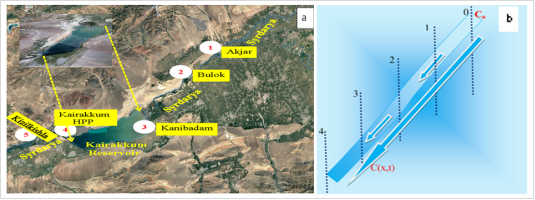
Figure 1. Water sampling points from the Syrdarya River (1- Akjar, 2- Bulok, 3- Kanibadam, 4- Kairakkum HPP, 5- Kizilkishlak).
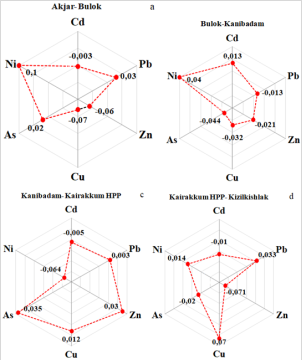
Figure 2. Deposition rate values of metals (As, Cd, Cu, Ni, Pb and Zn) in the aquatic environment between water sampling points To explain the obtained results, we can use the data from Table 1 on the influence of acid-base conditions (pH) on the formation of metal forms in aqueous medium.
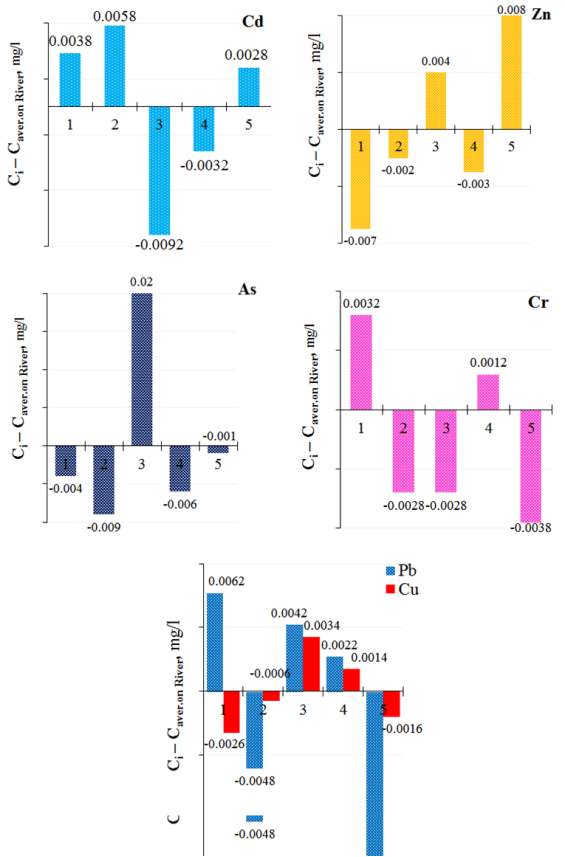
Figure 3. Concentrations of Cd, Zn, As, Pb, Cu and Cr at the respective water sampling points and their dynamics in the Sirdarya River.




 Share This Article
 Twitter
 Linked In
 Facebook
 Copy
Copy Download